10,000 Steps a Day: Where the Number Came From
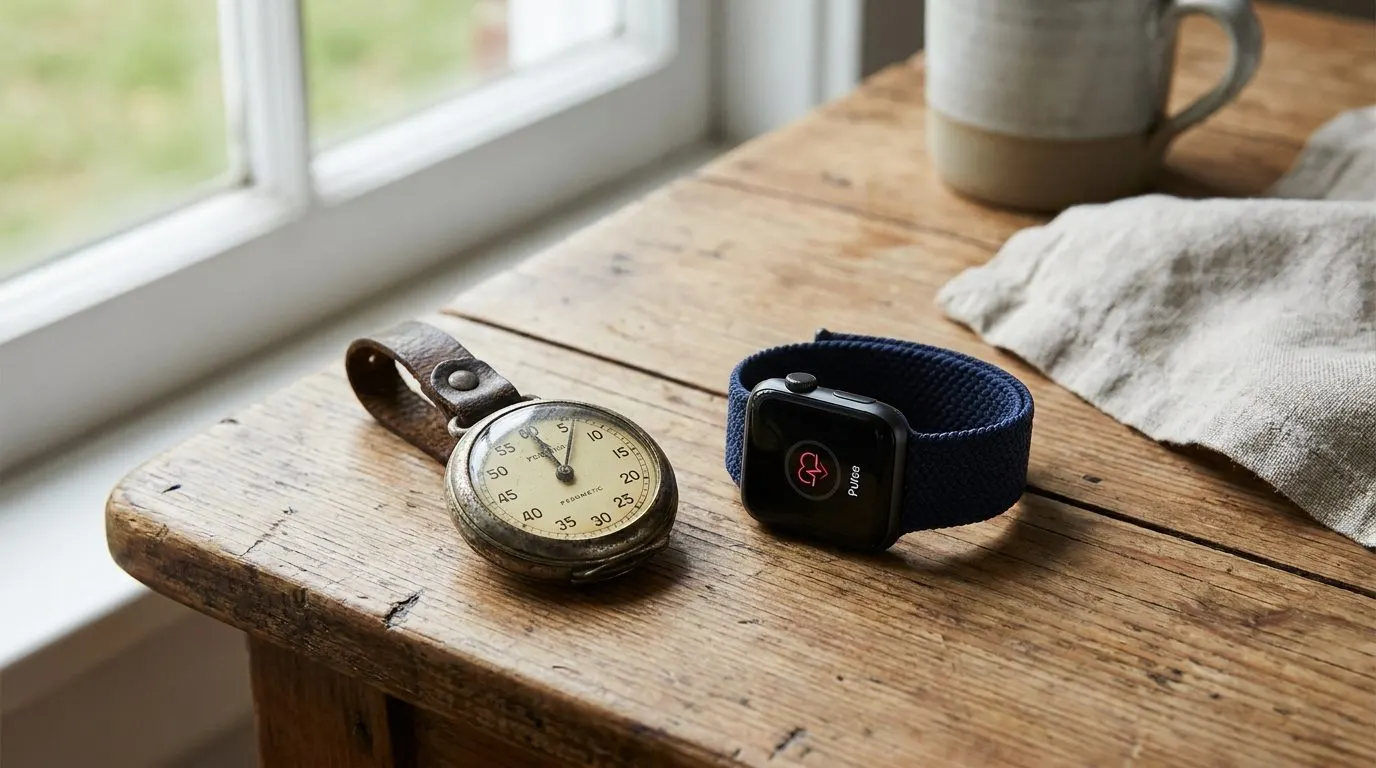
In 1965, a Japanese company launched a pedometer called the manpo-kei, which translates as “10,000-step meter.” The number was chosen because the character for 10,000 resembles a person walking, and because it sounded ambitious. No physiology study produced it. No trial validated it. Sixty years later it is installed as a default goal in roughly every fitness tracker on earth.
Marketing this durable deserves respect. It also deserves an audit.
What the mortality data actually shows
The best evidence we have pooled step data from 15 cohorts covering about 47,000 adults and tracked deaths over roughly seven years. The pattern was a curve, not a cliff. Compared with the least active quartile, who averaged around 3,500 steps a day, mortality risk fell steeply through the middle of the range and then flattened: around 6,000 to 8,000 steps daily for adults 60 and older, and around 8,000 to 10,000 for younger adults, with 40 to 53% lower risk in the upper quartiles (Paluch et al., 2022, The Lancet Public Health, PMID 35247352).
A 2025 dose-response analysis in the same journal landed in the same neighbourhood, with most of the benefit captured near 7,000 steps. The headlines read “10,000 steps debunked.” The more accurate reading: the biggest health returns come from getting sedentary people to 6,000 or 7,000, and the difference between 8,000 and 10,000 is small.
Standard caveat, named plainly: this is observational data. Healthier people walk more, and statistics can only partially untangle that. But the dose-response shape, consistent across cohorts and continents, is about as convincing as observational evidence gets.
For fat loss, steps are a different tool
Mortality curves are about health. Fat loss runs on different math, and here step counts play a role most people underestimate: they are the measurable proxy for NEAT, non-exercise activity thermogenesis, all the calories burned moving through ordinary life.
NEAT is the most variable part of daily energy expenditure, and it is the part that quietly collapses when you diet. Intake drops, energy dips, and the body economizes: fewer trips up the stairs, more sitting, less fidgeting. On GLP-1 medications the same slide happens. Clients routinely lose 2,000 to 3,000 daily steps during a deficit without making a single conscious decision. At roughly 35 to 45 calories per 1,000 steps for an average-sized adult, that silent drop can erase a third of a planned deficit.
This is why the right question is not “is 10,000 magic?” It is “what is my floor, and am I holding it?” The step target’s job during fat loss is defensive. It stops your daily burn from shrinking while you eat less.
Picking your number
Take a normal week’s average from your phone or watch. Add 1,500 to 2,000 to it. Hold that as a daily floor for a month, then reassess. A 4,000-step person who reaches a consistent 6,500 has captured a large share of the available health benefit and stabilized their energy expenditure. A 9,000-step person chasing 14,000 is mostly buying time costs.
Spread matters less than people think. Three ten-minute walks count exactly as much as one thirty-minute walk. After-meal walks earn a small bonus for glucose control.
What this looks like in coaching
Every fat-loss client at the practice gets a personal step floor, set from their own baseline, not from a 1965 advertisement. The floor is non-negotiable on diet days precisely because nobody feels like walking in week six of a deficit; that is the week it matters.
We check the weekly average, not the daily count, so one chaotic Tuesday does not become a moral event. When the average sags two weeks running, we treat it as data, the same as a stalled scale: usually it flags fatigue, under-fuelling or a schedule change worth solving.
Steps never replace strength training in our programs, and they never substitute for the deficit. They are the third leg: lifting protects muscle, food creates the deficit, steps keep the burn honest.
If you currently average 4,000, do not let anyone tell you 10,000 or nothing. The walk from 4,000 to 7,000 is where most of the prize is. The manpo-kei was a slogan. Your floor is a strategy.
This article is educational and is not medical advice. Diego Botezelli is a researcher and coach, not a physician — he does not diagnose, treat, or prescribe. Talk to your doctor before changing medication, supplements, or training, especially if you have a health condition or take prescription drugs.
Want a training plan built on this evidence?
Every program is periodized from the same literature this article cites, then adjusted to your body composition, your schedule and your training history.