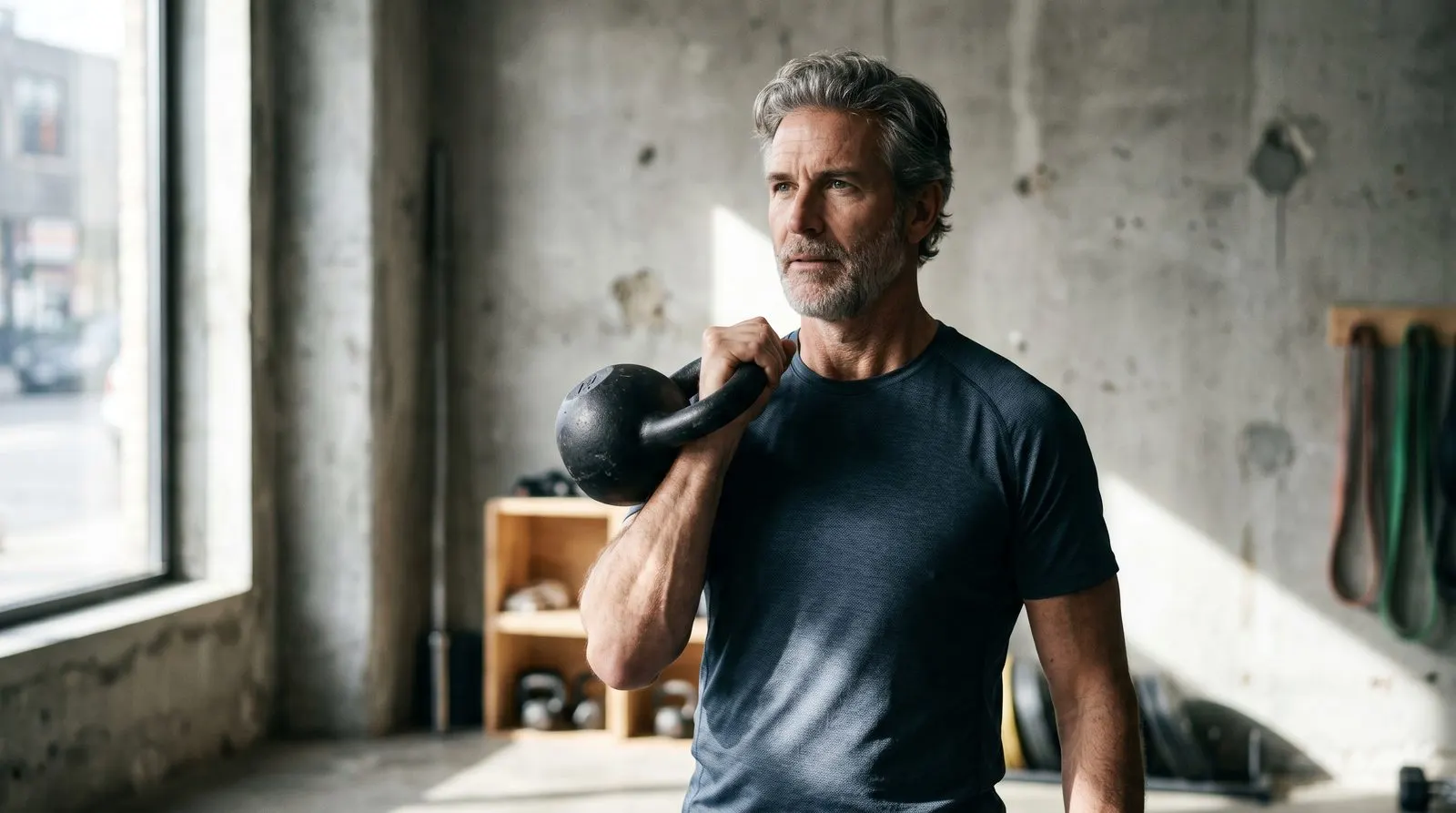
Andropause Is Real. Resistance Training Beats Most Of Its Symptoms.

A growing share of men in their forties and fifties walk into the practice with a confirmed low-testosterone diagnosis and a TRT prescription from a longevity clinic. Some of them have legitimate primary or secondary hypogonadism that warranted intervention. Most of them, on closer inspection, have age-typical testosterone decline amplified by sleep debt, visceral fat, untreated insulin resistance, and the complete absence of resistance training.
That distinction matters. The treatment differs.
What “low T” actually is in middle-aged men
Circulating testosterone in healthy men peaks in the early twenties and declines roughly 1–2% per year after age 30 (Travison et al., 2017, Journal of Clinical Endocrinology and Metabolism). By 50, the average man has serum total testosterone 30–40% below his 25-year-old self. That decline is normal, gradual, and asymptomatic in many men. In others — usually those with insulin resistance, poor sleep, or excess visceral fat — the same decline pushes symptoms past the clinical threshold: fatigue, low libido, decreased muscle mass, depressive symptoms, erectile dysfunction.
The threshold most labs use for “low” is total testosterone below 300 ng/dL. That number is statistical, not biological. A 45-year-old at 320 ng/dL is technically “normal.” Many of those men feel the same way a 200 ng/dL man feels.
What the evidence says about non-pharmacological intervention
Hayes et al. (2017) in Sports Medicine reviewed 24 trials of exercise interventions in men with low or borderline testosterone. Resistance training — particularly heavy compound lifts performed 2–4 times per week — produced consistent increases in total and free testosterone of 8–20%. The effect was larger in men who started with the lowest baseline numbers, smaller in already-trained men.
Camacho et al. (2013) in the European Male Aging Study showed that, in men 40–79, weight loss alone (without exercise or medication) produced testosterone increases comparable to TRT in the low-borderline subgroup. The mechanism is visceral fat — adipose tissue aromatizes testosterone into estradiol; less adipose, less aromatization, more free T.
Killer et al. (2017) in Hormone Research in Paediatrics (PMID 29387106) confirmed the third lever: sleep. Men sleeping under 5 hours per night had testosterone levels comparable to men 10 years older. Restoring sleep to 7+ hours over 8 weeks recovered most of the deficit.
What this changes in coaching
Three observations from running the protocol:
Heavy compound lifting matters more than the program format. Squats, deadlifts, presses, rows — performed at 75–85% 1RM for 4–6 reps — produce larger acute hormonal responses than circuit training or bodybuilding splits. The chronic effect on baseline testosterone is smaller and less reliable, but the muscle, the metabolic effect, and the strength gain all pay off regardless.
Body fat matters more than calories. Men in the practice carrying 25%+ body fat consistently report symptomatic improvement when they reach 18–20%. The aromatization mechanism is real and measurable. Caloric restriction alone, without training, doesn’t produce the same effect — it tends to lower testosterone further before it lowers fat enough to recover it.
Sleep is non-negotiable. We don’t optimize a man’s testosterone without first knowing his sleep is seven hours, dark, cool, and unbroken. Sleep apnea screening is part of intake for any man over 40 with low-T symptoms.
When TRT is the right call
Some men have legitimate primary or secondary hypogonadism — total testosterone consistently below 200 ng/dL with symptoms, after the lifestyle protocol has been given an honest run, sometimes with a confirmed pituitary or testicular cause. For those men, TRT is appropriate medicine, prescribed and monitored by a physician.
The practice doesn’t replace that physician. We work alongside, and we make sure the man on TRT is also lifting, sleeping, and eating in a way that lets the medication do its job rather than substituting for the lifestyle work.
The summary: most middle-aged men with low-T symptoms have a training problem, a sleep problem, and a body composition problem layered on top of normal age-related decline. Two of those three problems respond to training faster than they respond to a prescription. The third — sleep — is the one most men never address.
If you’re considering TRT, the right move is a six-month trial of structured lifting, deliberate sleep recovery, and visceral fat reduction first — with lab work at baseline and three months. If symptoms haven’t resolved, the medication conversation is on much better evidence at that point.
This article is educational and is not medical advice. Diego Botezelli is a researcher and coach, not a physician — he does not diagnose, treat, or prescribe. Talk to your doctor before changing medication, supplements, or training, especially if you have a health condition or take prescription drugs.
Want a training plan built on this evidence?
Every program is periodized from the same literature this article cites, then adjusted to your body composition, your schedule and your training history.