Sleepmaxxing and Fat Loss: The Real Sleep Connection
In one of the most cited diet studies of the last two decades, two groups of adults ate the same reduced-calorie diet for 14 days. One group got 8.5 hours in bed, the other 5.5. Both lost about 3 kg. The composition of that loss was the story: with short sleep, the share of weight lost as fat dropped by 55%, and the share lost as lean tissue rose by 60% (Nedeltcheva et al., 2010, Annals of Internal Medicine, PMID 20921542).
Same diet. Same scale result. Completely different body composition outcome. Sleep is not a recovery accessory to a fat-loss program. It is one of the variables that decides what the deficit removes.
Short sleep makes you hungrier, measurably
The hormonal mechanics are well mapped. Sleep restriction raises ghrelin, the hunger signal, and dampens leptin, the satiety signal. In the Nedeltcheva study, the short-sleep group reported significantly more hunger on the identical diet — same calories on the plate, measurably more appetite at the table. Brain-imaging work adds that a tired brain responds more strongly to high-calorie food cues and less strongly from the regions that handle restraint. The cravings that show up at 9 pm after a five-hour night are not a discipline failure. They are a predictable lab finding.
The real-world intake numbers match. When researchers took 80 habitually short-sleeping adults with overweight and coached them to extend sleep, the extension group cut their objectively measured intake by roughly 270 kcal per day compared with controls — with no diet instructions at all (Tasali et al., 2022, JAMA Internal Medicine, PMID 35129580). Nobody told them to eat less. They were simply less hungry. The intervention itself was a single sleep-hygiene counselling session, and participants kept living at home, working their jobs, eating whatever they chose. The extra intake disappeared on its own once the sleep debt did.
Run that arithmetic forward: 270 kcal per day is a theoretical 12 kg swing over a year, achieved by going to bed earlier. No supplement on the market has data within shouting distance of that.
What sleepmaxxing gets right and wrong
The sleepmaxxing trend — mouth tape, jaw straps, magnesium cocktails, $300 trackers, red-light routines — gets the priority right and the method wrong. The measurable benefits live in the boring basics; the gadgets are decoration, and some of them manufacture a new problem: orthosomnia, anxiety about sleep scores that itself degrades sleep.
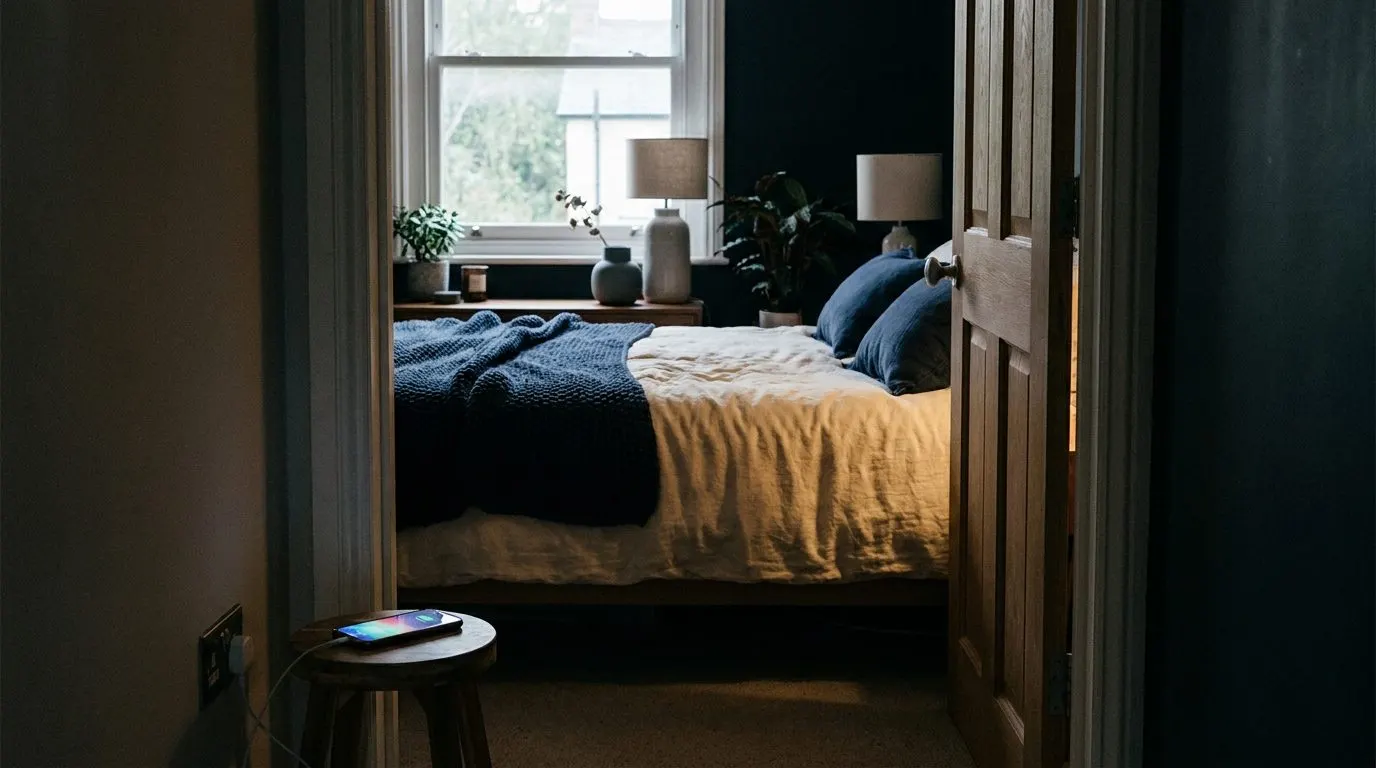
The basics with actual evidence behind them: a consistent sleep and wake time, including weekends. A cool, dark, quiet room — around 18°C (65°F) works for most people. A caffeine cutoff eight to ten hours before bed, because caffeine’s half-life of five to six hours means a 4 pm coffee is still a quarter-dose at midnight. Alcohol moved away from bedtime, since it fragments the second half of the night. Screens out of arm’s reach, less for the blue light than for the doomscrolling.
One limitation worth naming: most sleep-restriction studies are short, run in labs, and use fixed sleep windows. Real life is messier — shift work, young kids, perimenopausal night sweats. The direction of the effect is solid; the size in any individual life varies.
What this looks like in coaching
I treat sleep as a training variable with the same status as protein and steps. Every intake form asks for typical bed time, wake time and a 1–10 rest score. When a client reports under 6.5 hours, we fix that before tightening the deficit, because a hard deficit on short sleep is a recipe for losing muscle, white-knuckling cravings and quitting in week five.
The protocol is deliberately small. One change per week, starting with a fixed wake time, then a 30-minute earlier bedtime, then the caffeine cutoff. Clients track hours in bed next to their step count — two numbers, ten seconds a night. We do not chase sleep scores, and I actively talk clients out of buying trackers that grade them.
The pattern after four weeks is consistent: evening snacking drops without being targeted, training quality climbs, and the morning weight trend smooths out. Clients sleeping seven-plus hours hold onto visibly more strength through a 12-week cut than the ones grinding on six. The cheapest body-composition intervention I can prescribe does not come in a tub. It has a bedtime.
This article is educational and is not medical advice. Diego Botezelli is a researcher and coach, not a physician — he does not diagnose, treat, or prescribe. Talk to your doctor before changing medication, supplements, or training, especially if you have a health condition or take prescription drugs.
Want this applied to your own physiology?
The same evidence standard behind this article runs through every program I write, in person in Port Coquitlam or online.