In a Calorie Deficit but Not Losing Weight? Read This
In 1992, researchers at Columbia took a group of people who swore they could not lose weight on fewer than 1,200 calories a day and measured what was actually happening. The result became one of the most cited findings in obesity research: actual intake was 47% higher than reported, and physical activity was 51% lower (Lichtman et al., 1992, New England Journal of Medicine, PMID 1454084). Crucially, their metabolisms were normal. Nobody was lying, either. Their perception was simply wrong, by nearly half.
Thirty-four years later, this is still the most common answer to “I’m in a deficit but not losing weight.” You are not defying thermodynamics. One of four things is happening, and they are listed here in order of likelihood.
Suspect one: tracking drift
A deficit on paper is not a deficit in the body. The usual leaks: cooking oil (a tablespoon is 120 calories, and nobody measures the pour), dressings and sauces, bites and tastes while cooking, weekend relaxation that erases five disciplined days, restaurant meals logged as their home-cooked cousins, and liquid calories of every kind. Underestimating by 300 to 500 calories a day requires no carelessness at all. It is the human default, and it gets worse as the foods get more energy-dense.
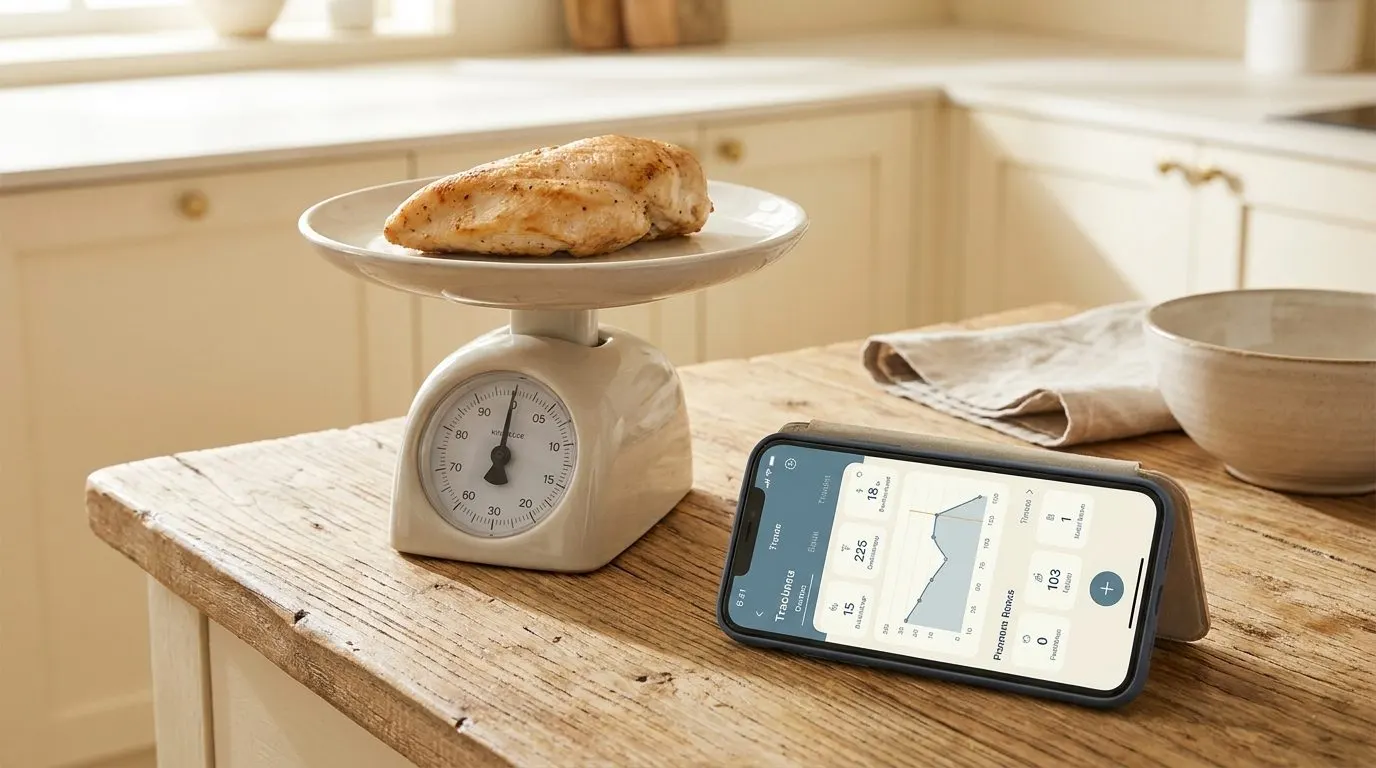
The test is not more effort. It is more precision for a short window: a food scale, everything logged including oils and drinks, for 14 days. Most stalls do not survive two weeks of weighed food.
Suspect two: water is hiding the fat loss
Fat loss and scale weight are different signals on different timelines. Water retention from a new training program, high sodium days, menstrual cycle phases, stress, and poor sleep can hold two to three kilograms for weeks while fat quietly leaves underneath. The infamous “whoosh” people report after a vacation or a deload is usually water clearing, revealing fat loss that already happened.
This is why single weigh-ins are noise. The 7-day rolling average of a morning weight, plus a monthly waist measurement, is the minimum honest dataset. A flat week means nothing. A flat 4-week trend means something.
Suspects three and four: your burn is smaller than the app says
Calculators estimate; bodies vary. Activity trackers routinely overstate exercise burn, and the calorie targets they generate inherit the error. Meanwhile, the body adapts to dieting: non-exercise movement falls without permission, and resting metabolism drops somewhat more than the lost tissue alone predicts. The extreme version made headlines when Biggest Loser contestants showed resting metabolic rates about 500 kcal/day below expected years after the show (Fothergill et al., 2016, Obesity, PMID 27136388). That was massive, rapid loss under extreme conditions; for typical dieters the adaptation is real but far smaller, on the order of 100 to 300 kcal/day. Worth respecting, rarely the whole story, and partly defended against by lifting and keeping protein high.
Notice what is not on the list: a broken metabolism, starvation mode where eating too little prevents loss, or a food that blocks deficits. Genuine medical contributors exist, untreated hypothyroidism among them, and a flat trend despite a verified deficit is a fine reason to see your physician. But the audit comes first, because the audit usually ends the mystery.
What this looks like in coaching
The practice runs a fixed 4-week audit for every stall, in this order, changing nothing else.
Weeks one and two: weighed and logged intake, every gram, every liquid. Daily morning weight feeding a rolling average. A step floor set at the client’s current normal, so movement cannot quietly fall while food tightens up.
Week three: if the trend has not bent, we recalculate the target from the client’s measured average, not the original calculator guess, and cut 10 to 15% from verified intake, usually 200 to 300 calories.
Week four: judge the trend, waist, and training log together. Strength sliding plus no loss means we check sleep, protein and stress before cutting further.
Across hundreds of these audits, roughly eight in ten stalls resolve in the first two weeks, the moment the scale and the notebook start agreeing with each other. The body keeps the books honestly. The audit just lets you read them.
This article is educational and is not medical advice. Diego Botezelli is a researcher and coach, not a physician — he does not diagnose, treat, or prescribe. Talk to your doctor before changing medication, supplements, or training, especially if you have a health condition or take prescription drugs.
Want this applied to your own physiology?
The same evidence standard behind this article runs through every program I write, in person in Port Coquitlam or online.