Glucose Monitors Without Diabetes: Useful or Noise?
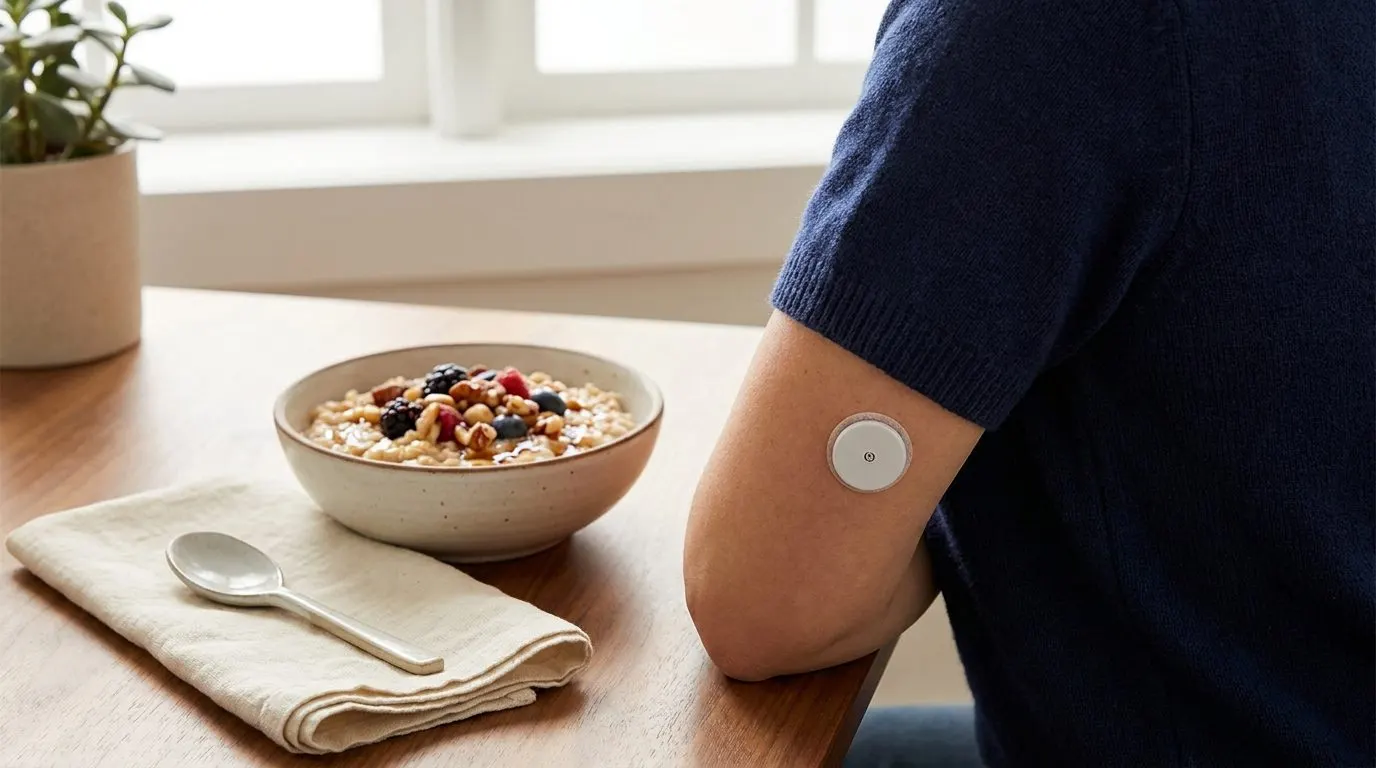
Since over-the-counter sensors like Stelo and Lingo launched in 2024 and 2025, hundreds of thousands of people without diabetes have started wearing continuous glucose monitors. The marketing promise is metabolic self-knowledge. The reality on social media is people panicking about a banana.
Here is the baseline the spike-influencers rarely show. When researchers put CGMs on 153 healthy, non-diabetic people for up to 10 days, average glucose sat at 98–99 mg/dL and participants spent a median of 96% of the day between 70 and 140 mg/dL (Shah et al., 2019, Journal of Clinical Endocrinology & Metabolism, PMID 31127824). Glucose rose after meals. Then it came down. That is not damage. That is digestion.
A spike is physiology, not pathology
Post-meal glucose excursions are the normal mechanics of absorbing carbohydrate. In a healthy person, insulin handles the rise within one to two hours. The healthy participants in the Shah study spent a median of just 30 minutes per day above 140 mg/dL — and these were people eating normally, not following any protocol.
The number that predicts disease risk is not the height of a single spike after oatmeal. It is the pattern: fasting glucose drifting upward over years, excursions that stay elevated for hours, time above 140 creeping from minutes toward hours. A CGM worn for two weeks cannot diagnose any of that, and an isolated reading of 150 after pasta means close to nothing.
Where the data gets genuinely interesting
The honest case for a short CGM experiment is that glucose responses are surprisingly individual. The landmark Israeli study of 800 people measured responses to 46,898 meals and found that two people eating identical food can produce opposite glycemic responses — one spiking to bread, the other to ice cream (Zeevi et al., 2015, Cell, PMID 26590418). Microbiome, body composition, sleep and activity all shaped the curves.
A sensor can also make three useful behaviours visible. A 10–15 minute walk after a meal measurably flattens the curve. Eating protein and vegetables before the carbohydrate in the same meal lowers the peak. A short night of sleep raises the next day’s responses to the same breakfast. Watching that happen on your own arm, in your own data, is more persuasive than reading about it in anyone’s article, including this one.
Where it goes wrong
The failure mode I see is food anxiety dressed up as optimization. People start fearing fruit, skipping carbohydrate before training, and chasing a flat line — which is not even desirable, since glucose is supposed to rise when you eat and when you train hard. Sensor error compounds the problem: consumer CGMs read interstitial fluid, lag blood glucose by 10–15 minutes, and can run 10–20% off, which means a “scary” 145 might be a boring 125.
There is also no evidence yet that CGM use improves outcomes in people without diabetes. No trial has shown better weight loss, better insulin sensitivity or fewer diagnoses from wearing one. The device measures; it does not treat. Insulin sensitivity is built the unglamorous way — muscle, deficit when needed, sleep, movement — and none of that requires a sensor.
What this looks like in coaching
I treat CGMs as a four-week teaching tool, not a permanent accessory. Clients with prediabetic labs, strong family history of type 2 diabetes, or PCOS get the most from a sensor; a lean, active 35-year-old usually learns little beyond what a step counter already told them.
The experiment runs like this. Two weeks of normal eating to establish a baseline, no changes allowed. Then two weeks of deliberate tests: the same meal with and without a 15-minute walk after, carbohydrate alone versus carbohydrate after protein, a late dinner versus an early one. The client keeps notes, and we review the curves together so a 140 after rice gets interpreted as physiology rather than failure.
Then the sensor comes off. The behaviours stay: post-meal walks, protein first, a consistent sleep window. If the baseline data looked off — fasting readings consistently above 100, excursions lingering past two hours — that goes to the client’s physician with the raw report, because diagnosis is their job, not the sensor’s. Four weeks of information, zero years of anxiety. That is the right dose.
This article is educational and is not medical advice. Diego Botezelli is a researcher and coach, not a physician — he does not diagnose, treat, or prescribe. Talk to your doctor before changing medication, supplements, or training, especially if you have a health condition or take prescription drugs.
Want this applied to your own physiology?
The same evidence standard behind this article runs through every program I write, in person in Port Coquitlam or online.