How Much Protein Do You Really Need Per Day?
The most-quoted protein number is 0.8 grams per kilogram of body weight per day. It is also the most misunderstood. That figure is the amount required to prevent deficiency in a sedentary adult, set as a floor to stop muscle and tissue breakdown. It was never meant to describe the intake that builds muscle, controls hunger or protects lean mass during a diet.
For an adult between 30 and 65 who is trying to lose fat and keep muscle, the working range is higher: roughly 1.6 to 2.2 grams per kilogram per day.
Where the higher number comes from
A meta-analysis of 49 studies and 1,863 participants found that protein supplementation increased gains in strength and fat-free mass during resistance training, with the benefit leveling off around 1.62 grams per kilogram per day (Morton et al., 2018, British Journal of Sports Medicine, PMID 28698222). Past that point, more protein did not add more muscle in healthy young trainees.
That 1.6 figure is the muscle-building plateau under training. Two things push the practical target higher. First, during a calorie deficit the body is more likely to pull from muscle, so a bit more protein protects lean mass. Second, protein is the most satiating macronutrient and carries the highest thermic effect, meaning you burn more digesting it than you do carbohydrate or fat. For dieting adults, the top of the range, closer to 2.0 to 2.2 grams per kilogram, makes sense.
A note on the evidence: most of these trials run on younger, trained people. Older adults are anabolically resistant and often need to sit at the higher end just to get the same response. The meta-analysis itself found the effect of protein shrank with age, which argues for more, not less, after 50.
Turning the number into food
A 75-kilogram adult targeting 1.8 grams per kilogram needs about 135 grams of protein a day. Spread across four meals, that is roughly 30 to 40 grams per meal. That is where the spreadsheet becomes a grocery list.
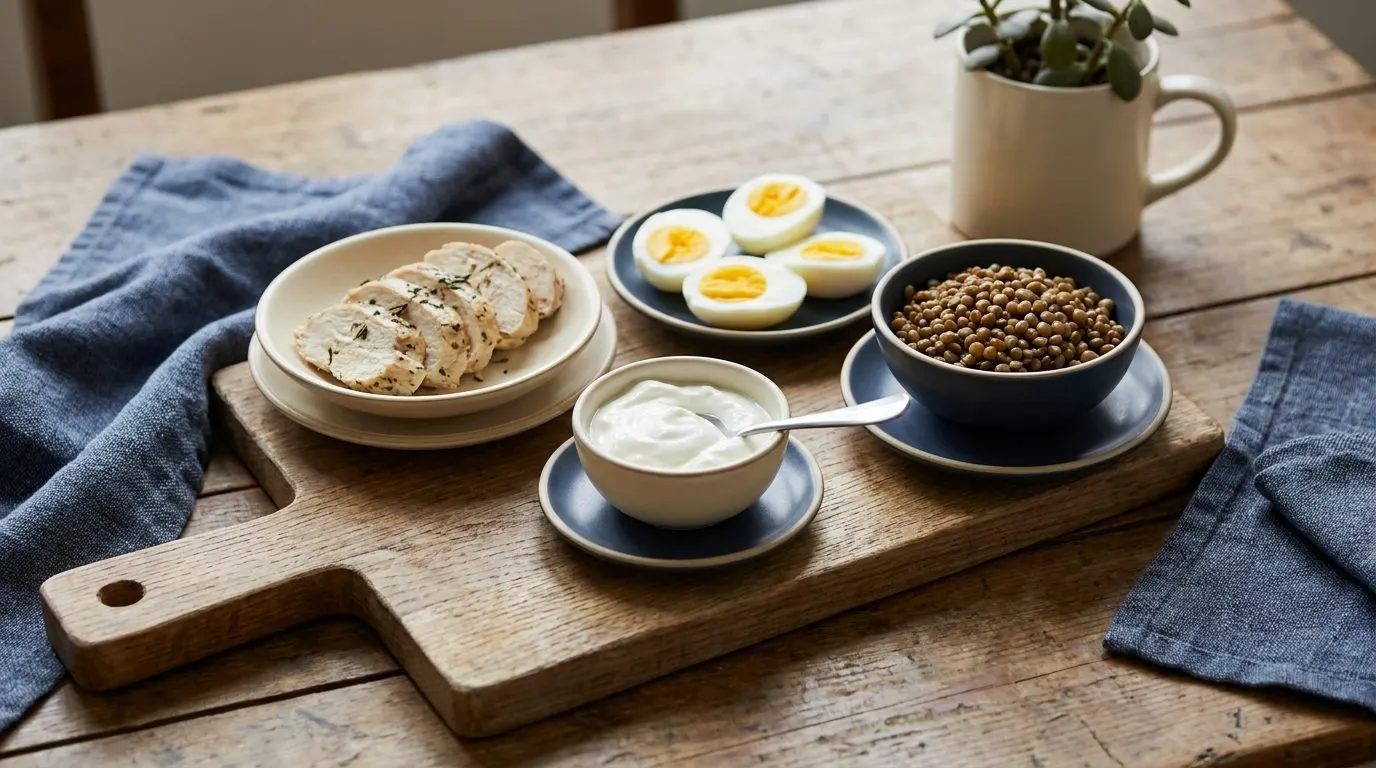
Thirty grams of protein looks like a chicken breast, a large can of tuna, a cup of Greek yogurt with a scoop of whey, or three to four eggs plus cottage cheese. Hit that anchor three or four times a day and the daily total takes care of itself. You stop tracking grams once the meals are built around a protein source.
What this looks like in coaching
Almost no one I work with starts at their target. The typical adult walks in eating 60 to 90 grams a day, most of it loaded at dinner, with a breakfast that is mostly carbohydrate.
The first change is structural, not numerical. We build a 30-gram protein anchor into breakfast, which is usually the meal carrying the least. That single shift often adds 20 to 25 grams to the daily total before we touch anything else. Then we set a per-meal floor and let the days settle.
I do not ask clients to weigh food forever. We weigh long enough to calibrate the eye, then move to portions: a palm of protein at each meal for most women, one and a half to two palms for most men. The goal is a number you hit on autopilot in a busy week, not a perfect log that collapses the moment life gets loud. Protein is the one macro worth being slightly obsessive about, precisely so you can be relaxed about the rest.
This article is educational and is not medical advice. Diego Botezelli is a researcher and coach, not a physician — he does not diagnose, treat, or prescribe. Talk to your doctor before changing medication, supplements, or training, especially if you have a health condition or take prescription drugs.
Want this applied to your own physiology?
The same evidence standard behind this article runs through every program I write, in person in Port Coquitlam or online.