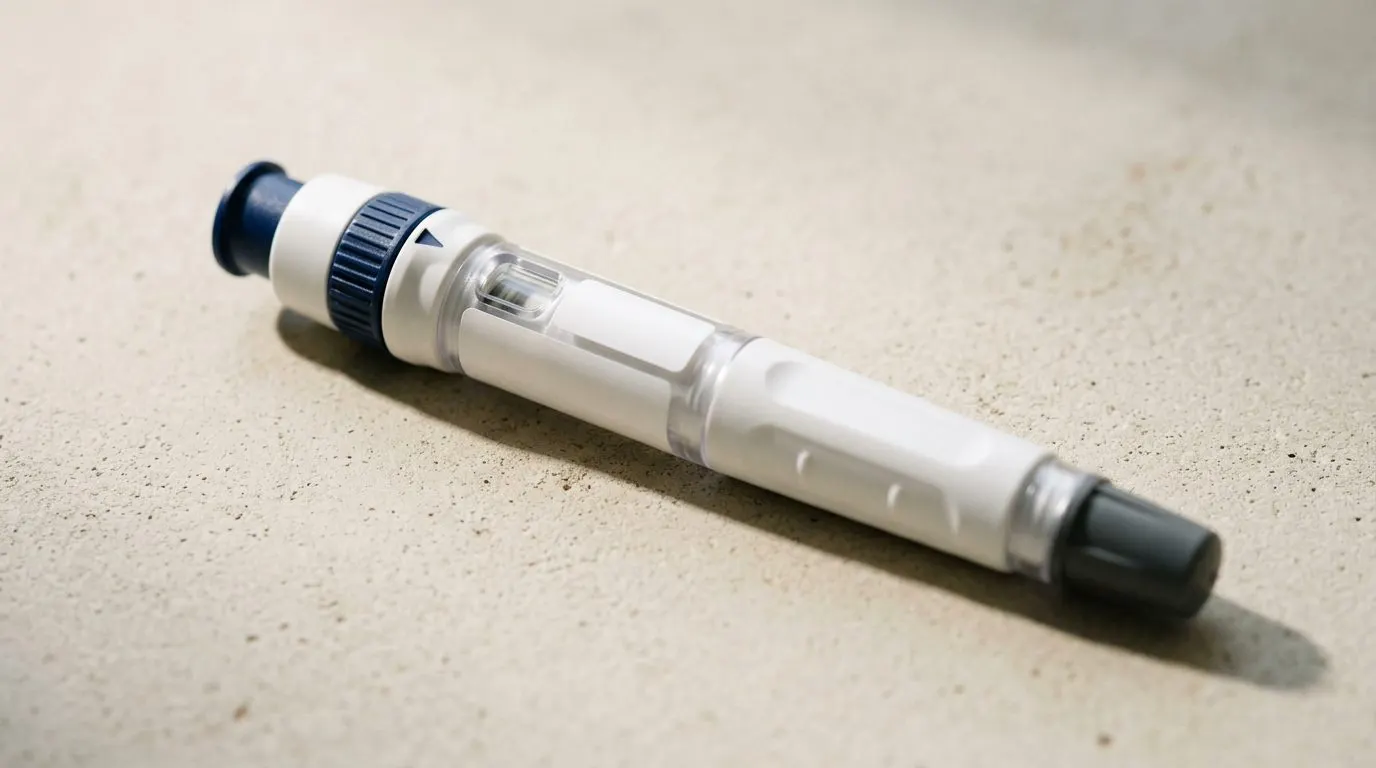
Ozempic Face: What Causes It and How to Limit It

A dermatologist in New York coined the phrase “Ozempic face” in 2023, and it has outlived every attempt to retire it. The look is real enough: hollow temples, deflated cheeks, deeper nasolabial folds, skin that suddenly seems two sizes too big. Facial plastic surgery journals now publish guidance on managing it (Sciscent et al., 2025, Facial Plastic Surgery & Aesthetic Medicine, PMID 39056124).
Here is what the name gets wrong. The drug does not attack your face. There is no semaglutide receptor in your cheeks that dissolves fat on contact. What you are seeing is ordinary rapid weight loss, displayed on the one body part nobody can hide.
The actual mechanism
Facial volume is mostly fat pads, supported by muscle and bone, draped in skin. Lose a large amount of total body fat and the facial fat pads shrink along with everything else. In STEP 1, participants lost an average of 14.9% of body weight over 68 weeks (Wilding et al., 2021, New England Journal of Medicine, PMID 33567185), and a meaningful fraction of total loss on GLP-1s is lean tissue. That matters for the face too, because muscle contributes structure, and because rapid loss with low protein affects skin quality.
Age stacks the deck. After 40, skin elasticity is already declining, collagen production is slower, and facial fat pads have begun migrating downward on their own schedule. A 25-year-old who loses 15% of body weight usually gets a sharper jawline. A 52-year-old who loses the same amount in eight months can look like they aged a decade, because the skin does not retract at the speed the fat left.
Anyone who lost a lot of weight before GLP-1s existed knows this. Bariatric surgery produced the identical face for decades. We just never named it after the operation.
What actually limits it
Slow the rate. This is the biggest lever. Losing 0.5 to 1% of body weight per week gives skin and soft tissue time to adapt; 1.5% or more per week does not. If the scale is falling faster than that, raise intake slightly within your plan and talk to your prescriber about the titration schedule. Dose decisions stay with the physician; the dinner plate is yours.
Protect lean mass everywhere. The same protocol that saves your quads helps your face: at least 1.6 g of protein per kg per day and resistance training 2 to 3 times weekly. Longland et al. (2016, American Journal of Clinical Nutrition, PMID 26817506) showed that high protein plus lifting preserved and even built lean tissue in a severe deficit. Adequate protein also supplies the amino acids collagen synthesis runs on.
Hydration and the boring skin basics. Dehydration exaggerates facial hollowing, and GLP-1 users chronically under-drink because thirst dims along with appetite. Two litres a day as a floor. Sunscreen and sleep do more for skin quality than any serum.
Know the limits. Past a certain amount of loss, especially past 50, some volume change is the honest price of a much healthier body. Fillers and skin treatments exist, and the surgical literature discusses them, but they are cosmetic choices to make from a position of health, not requirements.
What does not work: facial exercises sold on social media, collagen gummies promising facial restoration, and stopping the medication abruptly out of panic, which usually trades a cosmetic complaint for weight regain.
What this looks like in coaching
When a client raises the gaunt-face worry, we treat it as a dashboard light, not a vanity issue. A hollowing face usually means the loss rate is too hot, protein is too low, or both.
The audit takes one week: average daily protein, weekly rate of loss, training sessions completed, water intake. In practice the most common finding is a client losing 1.5 to 2% of body weight per week on 60 g of protein per day, thrilled with the scale and quietly alarmed by the mirror.
The fix is the muscle-first playbook with the thermostat turned down: protein up to 1.6 to 2.2 g/kg, two to three strength sessions weekly, weight loss slowed to about 0.75% per week, hydration tracked for two weeks until it becomes automatic.
Faces respond on a lag, but they respond. More importantly, the body under the face keeps its muscle, and that is the asset that pays out for the next thirty years.
This article is educational and is not medical advice. Diego Botezelli is a researcher and coach, not a physician — he does not diagnose, treat, or prescribe. Talk to your doctor before changing medication, supplements, or training, especially if you have a health condition or take prescription drugs.
On a GLP-1 and want to keep your muscle?
I coach GLP-1 clients alongside their prescribing clinician’s plan: protein targets, strength training and body-composition tracking, with the aim of losing fat while keeping the muscle you have.